
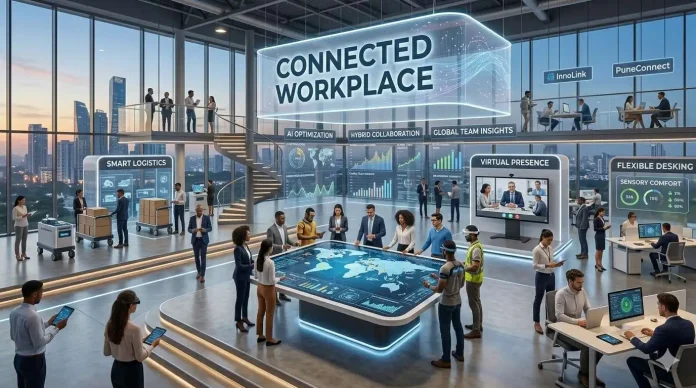

Connected Workplace | Smart Office | IoT Workplace | Regional Breakdown | April 2026 | Source: MRFR
| $87.3B | 22.4% | $11.2B |
|---|---|---|
| Market Value by 2035 | CAGR (2025-2035) | Market Value in 2024 |
Connected Workplace Market
Key Takeaways
-
Connected Workplace Market is projected to reach USD 87.3 billion by 2035 at a 22.4% CAGR.
-
IoT-enabled smart office solutions and hybrid work technologies are the dominant structural growth drivers.
-
Space utilization analytics and smart building automation are gaining traction among enterprises demanding operational efficiency.
-
Cisco, Microsoft, Honeywell, Johnson Controls, Siemens, Schneider Electric, and Crestron lead competitive supply.
-
North America leads adoption; Asia-Pacific accelerates through smart building investments.
The Connected Workplace Market is projected to grow from USD 11.2 billion in 2024 to USD 87.3 billion by 2035 at a 22.4% CAGR, driven by the mass-market adoption of IoT-enabled workplace solutions across enterprise offices, the expansion of hybrid work technologies into space utilization analytics, and the proliferation of smart building automation platforms that directly reduce energy costs and improve employee productivity.
Market Size and Forecast (2024-2035)
| Metric | 2024 Value | 2035 Projected Value / CAGR |
|---|---|---|
| Connected Workplace Market | USD 11.2B | USD 87.3B | 22.4% CAGR |
Segment & Technology Breakdown
| Technology | Segment | Primary Buyer | Key Driver |
|---|---|---|---|
| Smart Building Automation | Enterprise, Corporate | Facility Managers | Energy efficiency, comfort |
| Space Utilization Analytics | Hybrid Offices | Workplace Strategists | Desk optimization, occupancy tracking |
| IoT Sensors & Networks | All Workspaces | IT Directors | Real-time environmental monitoring |
| Connected Collaboration | Meeting Rooms | HR & IT Teams | Video conferencing, room booking |
What Is Driving the Connected Workplace Market Demand?
-
Hybrid Work Transformation: The shift to hybrid work models is driving investment in connected workplace technologies, with organizations reporting 30-50% improvement in space utilization and 20-35% reduction in real estate costs through occupancy analytics and hot-desking solutions.
-
Energy Efficiency Mandates: Smart building automation systems are reducing energy consumption by 20-30%, with organizations achieving significant cost savings and meeting sustainability targets through IoT-enabled HVAC and lighting controls.
-
Employee Experience Focus: Connected workplace technologies improving comfort and convenience are linked to 15-25% higher employee satisfaction scores, with smart meeting room booking and environmental monitoring directly impacting productivity and retention.
-
IoT Sensor Cost Reduction: Declining sensor costs and improved battery life are enabling widespread deployment of connected workplace technologies, with organizations reporting 40-60% reduction in implementation costs and 3-5x ROI through operational efficiencies.
KEY INSIGHT
Enterprise organizations deploying connected workplace solutions report a 35% improvement in space utilization efficiency and a 25% reduction in energy consumption, with validated ROI payback periods of 12-18 months across North American and European corporate offices and hybrid workplaces.
Get the full data — free sample available:
→ Download Free Sample PDF: Connected Workplace Market
Includes market sizing, segmentation methodology, and regional forecast tables.
Regional Market Breakdown
| Region | Maturity | Key Drivers | Outlook |
|---|---|---|---|
| North America | Mature | Hybrid work adoption, energy regulations | Steady; smart building leading |
| Europe | Strong | ESG mandates, building efficiency standards | Strong; IoT analytics accelerating |
| Asia-Pacific | High-Growth | Smart city initiatives, office modernization | Fastest-growing; China, Japan, SE Asia lead |
| Middle East & Africa | Expanding | Premium office developments | Growing; smart building adoption |
| South America | Emerging | Corporate office modernization | Moderate; entry-level IoT growth |
Competitive Landscape
| Category | Key Players |
|---|---|
| Building Automation | Honeywell, Johnson Controls, Siemens, Schneider Electric |
| Workplace Analytics | Cisco (DNA Spaces), Microsoft (Places), VergeSense, Density |
| Collaboration Hardware | Crestron, Logitech, Poly, Zoom Rooms |
| IoT Platforms | AWS IoT, Microsoft Azure IoT, Google Cloud IoT |
Outlook Through 2035
IoT-enabled workplace standardization, hybrid work analytics ubiquity, and smart building automation integration will define the connected workplace market through 2035. Vendors investing in predictive space utilization, employee experience analytics, and seamless workplace app integration will capture the highest-margin enterprise and corporate contracts as connected workplace transitions from efficiency tool to essential hybrid work infrastructure.
Access complete forecasts, segment analysis & competitive intelligence:
→ Purchase the Full Connected Workplace Market Report (2025-2035)
*10-year forecasts | Segment & application analysis | Regional data | Competitive landscape | 100+ pages*
Keywords: Connected Workplace | Smart Office | IoT Workplace | Space Utilization | Building Automation | Hybrid Work Technology | Workplace Analytics | Smart Building
© 2025 MarketResearchFuture (MRFR) · All Rights Reserved · marketresearchfuture.com
All market projections are forward-looking estimates sourced from MRFR’s proprietary research reports and subject to revision.


